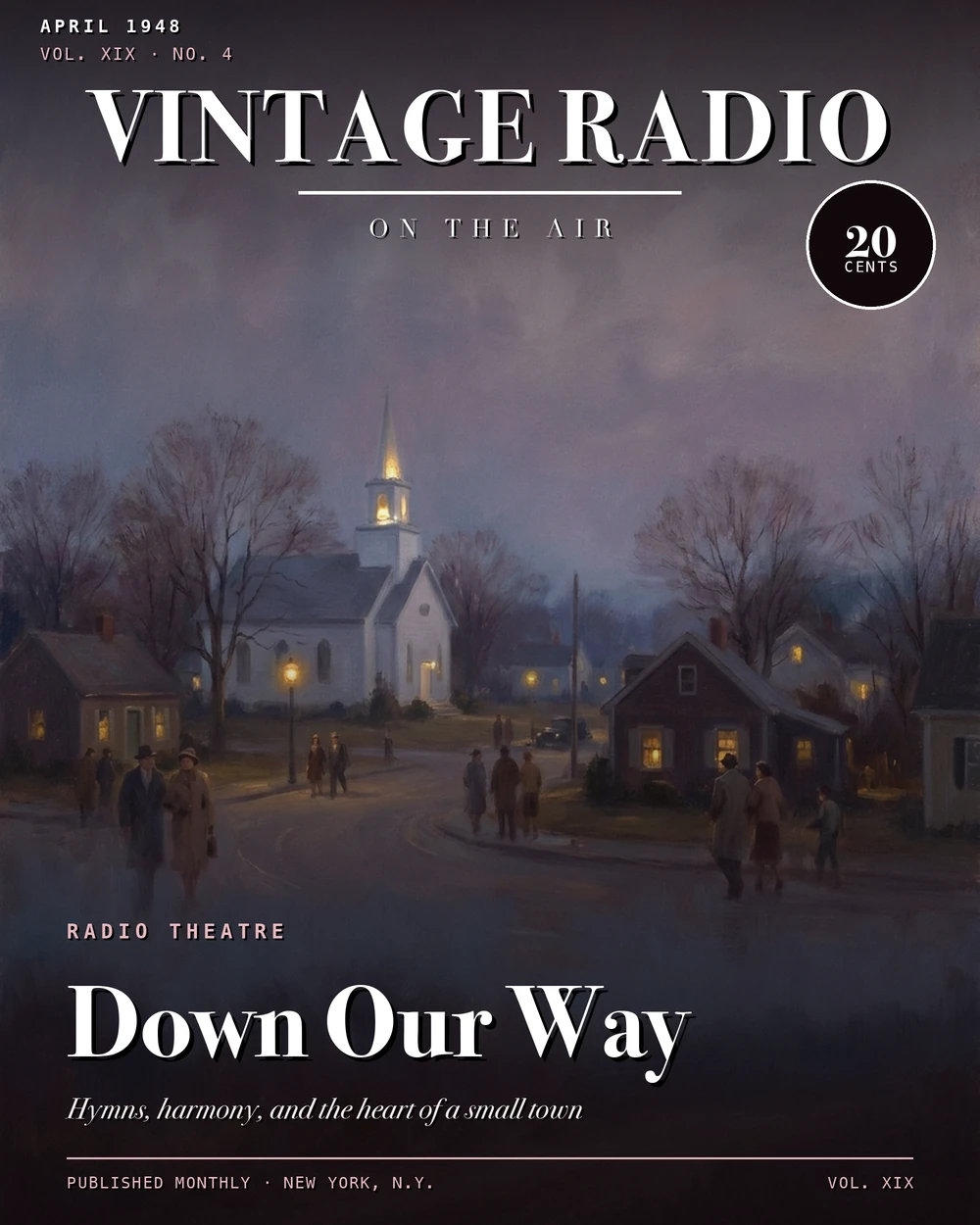
Down Our Way
The Town at the Center of It All
Most old-time radio shows built their worlds around a detective, a comedian, or a family name in the title. Down Our Way built its world around a grocery store. Eli Jenkins, the town grocer, was the character everyone in the community turned to when something went wrong — a missing dog, a farm about to be auctioned off, a prowler in the neighborhood, a neighbor thinking about leaving town. That setup gave the show a natural, unhurried rhythm: trouble arrives, the community pulls together, and life in a small American town goes on. It was a quiet premise, and it suited the series well.
The local choir that met regularly at Eli's grocery store gave the show its distinctive sound. Rather than featuring outside performers or guest musicians, the recurring cast members themselves sang the hymns, weaving the music into the fabric of each episode's story. That's what set Down Our Way apart from the era's more performance-oriented music programs — the music didn't interrupt the drama, it grew out of it, the same way hymnal singing was part of daily life in the kind of town the show was portraying.
When It Was Made
The precise premiere date for Down Our Way is harder to pin down than most. Multiple OTR research sources consistently place the series in the early 1930s, making it an early example of the small-town community drama format. That would put it among the pioneering syndicated programs of the period rather than among the more polished network productions of the 1940s. No final broadcast date has been established, and the show doesn't appear in any of the standard OTR reference books, which means the usual markers researchers rely on — network logs, sponsor records, trade press coverage — simply aren't available for this one.
What is known is that the series is believed to have been syndicated through Commodore Productions, the company operated by producer Walter White Jr. Syndicated shows of this kind were produced independently and sold station by station rather than carried over a national network, which partly explains why the historical record is so sparse. Programs distributed that way often left fewer traces in the trade press and industry archives than their network counterparts.
What the Episodes Were About
The 26 surviving episodes cover the full range of small-town life, and the episode titles alone give a good sense of the show's texture: The New School Teacher, Raising Money for Homeless Kids, Stopping a Farm Auction, Fire Prevention Week, Patience Plans on Leaving, Sam Mullins Breaks into the Store. These aren't exotic premises — they're the kinds of situations that would have been immediately familiar to anyone living in a rural or small-town community during the early decades of American radio.
The dramatic backbone of each episode was the same: neighbors helping neighbors, problems worked out through collective effort, and faith threaded through daily life. Cliff's Birthday Party, The Jacob's Thirty-Third Anniversary, and Ben's New Organ suggest episodes built around celebrations and personal milestones as much as crises. Brownie Is Missing and Prowler Troubles point toward the lighter, more domestic end of the show's range. Across those 26 episodes — each running approximately 26 minutes — the series accumulates a picture of community life that's consistent and detailed, even if the individual stories are modest in scale.
The Sound of It
The choir at Eli's grocery store was the show's musical anchor. These weren't professional performers brought in to fill airtime between scenes — they were characters in the story, neighbors who gathered regularly and sang together as a natural part of community life. The hymnals they sang gave each episode a tone that was warm without being sentimental, and religious in a community-practice sense rather than a preaching one.
That approach made Down Our Way something of a hybrid. OTR researchers generally classify it as a comedy/drama with music woven in, rather than a straightforward music program. The choir singing wasn't a performance inserted into a drama; it was part of how the world of the show worked. Whether a given episode leaned more toward the comic or the dramatic side, the musical texture stayed consistent — congregational, familiar, rooted in the same traditions as the townspeople themselves.
How It Survives
Down Our Way is documented only briefly in Jay Hickerson's Ultimate Guide and in Dave Godin's episode log. It doesn't appear in any of the major OTR reference books, which puts it among the more obscure programs in the surviving radio catalog. That obscurity makes the completeness of what survives all the more notable: a Certified Complete set was released on July 18, 2008, accounting for and verifying all 26 circulating episodes on a single disc. The full collection runs approximately 11 hours and 33 minutes.
For a syndicated series from the early 1930s with no network affiliation and minimal press coverage, having the complete run accounted for is unusual. Many programs from the same period survive only in fragments, if at all. The fact that the set was certified as complete means the series exists today in its entirety — all 26 episodes, in the order they were logged, without gaps. For a show this far outside the mainstream OTR canon, that's a meaningful piece of the historical record to have intact.